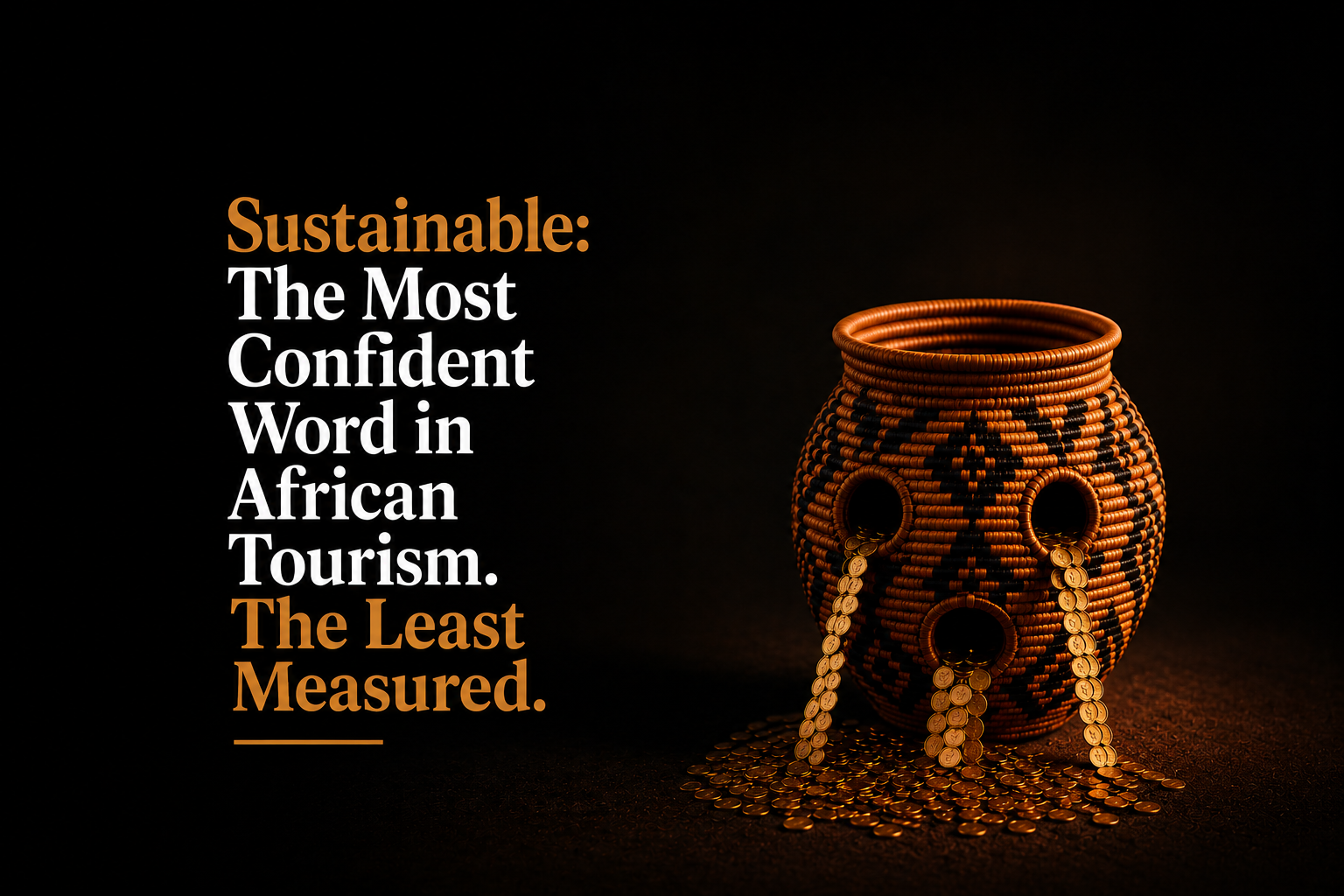
I have sat in enough boardrooms, panels, and industry working sessions to say this plainly: “sustainable tourism” has become African tourism’s most confident phrase — and its least measured one.
We’ve built an entire vocabulary around it. Community benefit. Local empowerment. Responsible travel. Conservation partnership. And almost none of it comes attached to a number anyone can actually check.
Ask a lodge what percentage of guest spend directly reaches the community whose land or culture the marketing leans on. Ask a tourism board how much destination revenue actually stays in-country versus flowing back out.
Chances are, you’ll get a story. A photograph. A quote from a beneficiary. Rarely a verifiable figure. Almost never an audited one.
This is not a small gap. It is the gap.
Other industries have been pushed toward real disclosure — supply chains, sourcing, impact reporting, financial statements. Tourism hasn’t faced that same pressure yet, and it shows: we can tell you exactly what a traveler experienced, and almost never what they left behind.
It Shows Up in the Numbers Too
By 2015, Africa held a 4.4% share of worldwide tourism arrivals — but captured only a 2.3% share of worldwide tourism receipts, according to UNCTAD.
In plain terms: we’re pulling in close to our promised share of the world’s travelers, but going home with less than half the money that volume should be worth.
Whatever “sustainable” means, it should show up here first, at the level of who actually gets paid.
Right now, it mostly doesn’t.
What’s Happening to the Money
There’s a term for this: leakage.
Picture tourism revenue as water poured into a bucket, where the bucket is the local economy. Leakage is the holes — money that pours in and pours straight back out, paying for imported goods, commissions to foreign booking platforms, profits repatriated abroad, salaries sent home instead of spent locally.
A “sustainable” claim that doesn’t account for the holes isn’t describing the water level. It’s describing how pretty the bucket looks.
Because Africa is not short on value.
We hold the landscapes, the wildlife, the cultures, the depth travelers are searching harder for every year.
What we’re short on is the infrastructure to measure, in numbers, how much of that value actually remains with the people who live here.
Bwindi, Uganda
One of the clearer attempts to measure this came from Bwindi, Uganda.
In a 2010 study published in the Journal of International Development, researcher Chris Sandbrook tracked the money from gorilla-trekking tourism there and found that for every $100 a tourist spent, roughly $75 left the area. Only $25 stayed locally.
And yet that $25 was still bigger than every other source of income to that community combined — farming, trade, remittances, everything.
Read that twice.
This isn’t a story of tourism failing a community — it’s tourism being the single biggest thing holding that community up, while still losing three-quarters of its own value on the way out.
Imagine that community with $50 staying instead of $25.
That gap, not the failure, is the real opportunity in front of us.
Whose Problem Is This, Actually
I’ve asked people in this industry a simple question: what percentage of what a guest spends actually stays here?
I’ve never once gotten a number back — not a single audited figure, from anyone.
I don’t think that’s because anyone is hiding something.
It’s because nobody has built us the tools to answer it. No shared standard, no template, no one asking for it.
This problem is an industry problem.
It runs through governments setting policy, destination marketing organisations writing the pitch, investors deciding who gets capital, airlines and platforms taking their cut before a dollar reaches the ground, hospitality groups structuring ownership, and operators too.
Everyone in that chain says “sustainable.”
Almost nobody is required to prove it.
Look at how most African tourism ministries report their own numbers, and you’ll see the same pattern at the highest level.
Most report what came in.
Very few report what stayed.
If you work in this industry anywhere on the continent, it’s worth pulling your own country’s latest tourism performance report and checking: does it tell you what tourism earned, or does it also tell you what tourism kept?
For most of us, I suspect it’s only ever been the first.
What Would Move This
Not another eco-certification — we have several, and a badge answers “did someone check this once,” not “is this true today.”
What Africa’s tourism sector needs is a shared measurement standard: a simple, common way for every player across the tourism value chain to calculate and disclose how much value is genuinely retained versus lost.
The African Union’s own Agenda 2063 tourism targets already call for a continental strategy — and that is the scale this conversation belongs at.
Governments, industry associations, investors, operators, hospitality groups, airlines, destination marketing organisations, conservation stakeholders, and media all have a role to play in building the systems behind it.
No single entity should carry that responsibility alone.
We can keep marketing “sustainable” as a feeling.
Or we can build the systems that allow us to measure it, disclose it, and mean it — continent-wide, across the entire industry.
Africa no longer needs to prove its value to the world.
The world already comes — for the landscapes, the wildlife, the cultures, the depth found nowhere else.
What we haven’t yet claimed is the other half of that story: the right to say, in numbers, how much of that value belongs to us, and to hold the world to it.
That is what real authority looks like for African tourism over the next decade.
Not just the power to attract the world’s attention — the power to account for what it’s worth, and to keep it.
The receipts, not just the rhetoric.
Part of an ongoing series interrogating the words African tourism uses, and what stands behind them.
Previous reflections in the series include “Untouched. Authentic. The Most Dangerous Words in African Tourism.” Read it here: Untouched. Authentic. The Most Dangerous Words in African Tourism.
If you’re working anywhere across the African tourism ecosystem — from policy and investment to hospitality, aviation, conservation, destination marketing, media, or operations — and thinking seriously about how African tourism measures value, reach us at hello@wangechigitahitravels.com.

1 Comment
Pingback: IMPACT: THE EASIEST CLAIM IN TOURISM. THE HARDEST TO PROVE. - Wangechi Gitahi Travels