How many tourists does it take to change a life?
Seriously. Because tourists have been coming to Africa for years. Decades. Generations even.
They have stayed in our hotels. Photographed our people. Visited our villages. Watched our wildlife. Bought our crafts. Donated to our schools. Planted trees. Supported conservation projects. They have “given back.” “Empowered communities.” “Made a difference.” And somewhere along the way, we started calling almost all of it impact.
Impact travel. Impact tourism. Impact investment. Impact experiences. Impact projects. Impact everywhere.
But I keep coming back to one very simple question: What actually changed?
Not how many people came. Not how many people were trained. Not how many jobs were “created”. Not how many trees were planted. Not how much money was donated. What changed?
Because perhaps we have become very good at documenting what tourism does and calling it what tourism changes. They are not necessarily the same thing.
A training happened. Great. Did anybody earn more? Jobs were created. Great. Who owns the business? Tourism revenue grew. Wonderful. How much stayed here? The community participated. Excellent. Participated as what—employees, performers, suppliers, decision-makers, owners?
And if we came back five years later, would whatever we are calling “impact” still be there?
That, for me, is where this conversation begins.
THE WOMAN IN THE PHOTOGRAPH
Take a woman somewhere in rural Africa. A photographer sees her. Perhaps she is standing outside her home. At a market. Carrying a child. Working. Talking. Simply going about her life. He takes her photograph.
Maybe she agrees. Maybe she doesn’t fully understand what she is agreeing to. Maybe somebody speaks to the chief. Maybe somebody receives $20. Maybe she receives something. Maybe she receives nothing.
But the photograph goes. She doesn’t.
Website. Brochure. Postcard. Magazine. Billboard. Tourism campaign.
Maybe an international tour operator uses it. Maybe a hotel does. Maybe a destination does. Maybe that photograph sells Africa for the next ten years. Thousands of people could see her face and think: I want to go there.
The photograph has done its job. It has created desire. Desire creates bookings. Bookings create revenue. Everybody can tell me the value of the campaign.
Can anybody tell me the value that reached the woman whose face helped sell it?
Does she know where her photograph ended up? Was she paid? Does she own any rights to it? Does she participate in any of the value her image continues to create? Ten years later, somebody could still be making money from her face. Is she?
That question bothers me. Because this isn’t really just about a photograph. Once you start asking the question, you begin seeing it everywhere.
The landscape sells. Who owns the value? The wildlife sells. Who owns the value? Culture sells. Stories sell. Food sells. Music sells. Our identities sell. Our faces sell. Africa sells.
So who owns the value? And perhaps more importantly: Who gets to keep it?
WE LOVE THE BIG NUMBERS
Tourism loves a big number. Arrivals. Receipts. Room nights. Occupancy. Jobs. GDP contribution. Millions. Billions. Record year. Another record year.
And those numbers matter.
I don’t think tourism has no impact. Far from it. I have spent too much of my life in this industry to believe that. I have seen what tourism can do.
Tourism creates jobs. It creates businesses. It brings foreign exchange. It creates markets. It can finance conservation. It can support infrastructure. It can create opportunities in places where few other industries can. At its best, tourism can genuinely transform lives.
But perhaps loving this industry also means being willing to ask more of it. Especially when we use big words.
Take employment. Women make up up to 69% of Africa’s tourism labour force, according to UN Tourism. That sounds impressive. And it is. Until you keep reading.
UN Tourism also notes that the majority of women in African tourism often occupy lower-level jobs. So I have another question: if women can make up such a significant proportion of the tourism workforce while remaining disproportionately concentrated at the lower end of its economic power structure, what exactly do we mean when we say tourism is “empowering women”?
Presence? Or power?
Because the two are not the same. A woman can work in tourism and still have very little power within tourism. She can serve the food without supplying it. Clean the room without owning one. Dance for the visitor without owning the cultural experience. Appear in the campaign without owning the image. Work in tourism for twenty years without ever owning a meaningful piece of the tourism economy.
So yes. Count the jobs. Then keep counting. How many managers? How many suppliers? How many business owners? How many shareholders? How much equity? How much decision-making power? How much of the actual tourism economy?
Employment matters. But employment is not ownership. Participation matters. But participation is not necessarily power.
NOW, FOLLOW THE MONEY
Here is another question I find myself asking. A tourist spends $1,000 on an African holiday. How much of that $1,000 stays in Africa?
Not passes through. Stays.
Once the international booking platform takes its commission, the overseas tour operator takes its share, the foreign airline is paid, the hotel imports what it needs, management fees are paid and profits are repatriated, how much is left? And then, of what remains, who got it?
Because saying tourism generated billions does not tell me how much of those billions remained in the destination economy.
Take Botswana. Professor Joseph Mbaiwa of the Okavango Research Institute has argued that Botswana retains only about 25% of the tourism revenue generated within its borders. His wider research on the Okavango Delta has also raised questions about foreign ownership, repatriation of tourism revenue and weak linkages between tourism and the domestic economy.
Think about that. A destination can be globally celebrated. Tourism can be growing. The lodges can be full. And we can still have to ask: How much of the value stayed?
But even that isn’t enough. Because saying money remained in a country still doesn’t tell me whether the people whose land, labour, culture, wildlife or stories helped create that value received a meaningful share of it.
The Gambia offers another interesting example. A tourism value-chain study by Jonathan Mitchell and Jojoh Faal found that about 14% of the Gambian part of the tourism value chain they studied flowed directly to poor people.
Fourteen per cent may immediately sound small. But here is what is interesting: the researchers considered it a much larger pro-poor outcome than they had expected. Why? Because local linkages were working.
Craft markets. Food supply. Non-managerial hotel staff. Guides. Taxis. Money was moving beyond the tourist and the hotel into other parts of the local economy.
And that is the point.
Perhaps the question isn’t simply: How much money did tourism make?
Perhaps we need to keep going. How much stayed? Who got it? How many times did it move through the local economy? Who owns the businesses receiving it? And after all of that—what changed?
Because revenue is one thing. What happens because of that revenue is another.
WHEN DID EVERYTHING BECOME IMPACT?
A training is held. Impact. A donation is made. Impact. A school is painted. Impact. A community receives tourists. Impact. Trees are planted. Impact. Jobs are created. Impact.
All of these can be good things. Some can be very good things. But why are we so quick to promote them to impact?
“We trained 300 women.” Great. What happened to the 300 women?
“We supported 40 local businesses.” Excellent. What changed in those businesses?
“We created employment opportunities.” Wonderful. Doing what? For how much? For how long? With what possibility of progression?
“We empower local communities through tourism.” Okay. How? No, seriously. How?
What can somebody do today that they could not do before? Did their income increase? Did they gain an asset? Did they enter a new market? Did they build a business? Did they acquire equity? Did they gain decision-making power? Did something become theirs? And did they still have it five years later?
Because if we cannot answer those questions, perhaps what happened was an activity. Maybe a worthwhile activity. But activity and impact are not automatically the same thing.
SO BEFORE WE CALL IT IMPACT…
I don’t think we need another complicated tourism framework. I think we need to become more comfortable asking very simple questions.
Before we call something impact, I want to know:
How much stayed? If tourism created value, how much remained in the destination economy?
Who got it? And please don’t just tell me “the community.” Who? Workers? Women? Young people? Farmers? Guides? Artists? Landowners? Local businesses?
Who owns something because of it? A business? Land? Equity? A brand? Intellectual property? A product? A place in the supply chain?
What actually changed? Income? Opportunity? Agency? Business growth? Market access? Conservation? Economic mobility?
Did that change last? Come back when the tourists have gone. When the photographer has left. When the donor funding ends. When the consultant has submitted the report. When the beautiful launch photographs have disappeared from LinkedIn. Come back in five years. Is the impact still there?
That’s what I want to know.
How much stayed? Who got it? Who owns something because of it? What changed? Did it last?
Maybe impact really does need to be that simple.
AND NO, TOURISM CANNOT FIX EVERYTHING
Before someone says it—no. I am not arguing that tourism should solve every problem in Africa. It cannot.
A hotel cannot fix an education system. A tour operator cannot eradicate poverty. A safari cannot solve structural inequality. And tourists certainly should not arrive in Africa believing it is their personal responsibility to “save” anybody.
That is not the argument. The argument is much simpler:
If we say tourism had an impact, surely we should be able to say what changed because tourism was there.
That’s it.
And if we can’t? Call it what it was. A training. A donation. A contribution. A project. A job. An experience. An activity.
There is nothing wrong with those words.
Not everything has to be impact to matter.
MAYBE THIS HAS ALWAYS BEEN ABOUT THE WORDS
This is the third time I have found myself interrogating one of tourism’s favourite words.
First: “Untouched.” “Authentic.” Who gets to define Africa?
Then: “Sustainable.” We say it confidently. But where is the measurement?
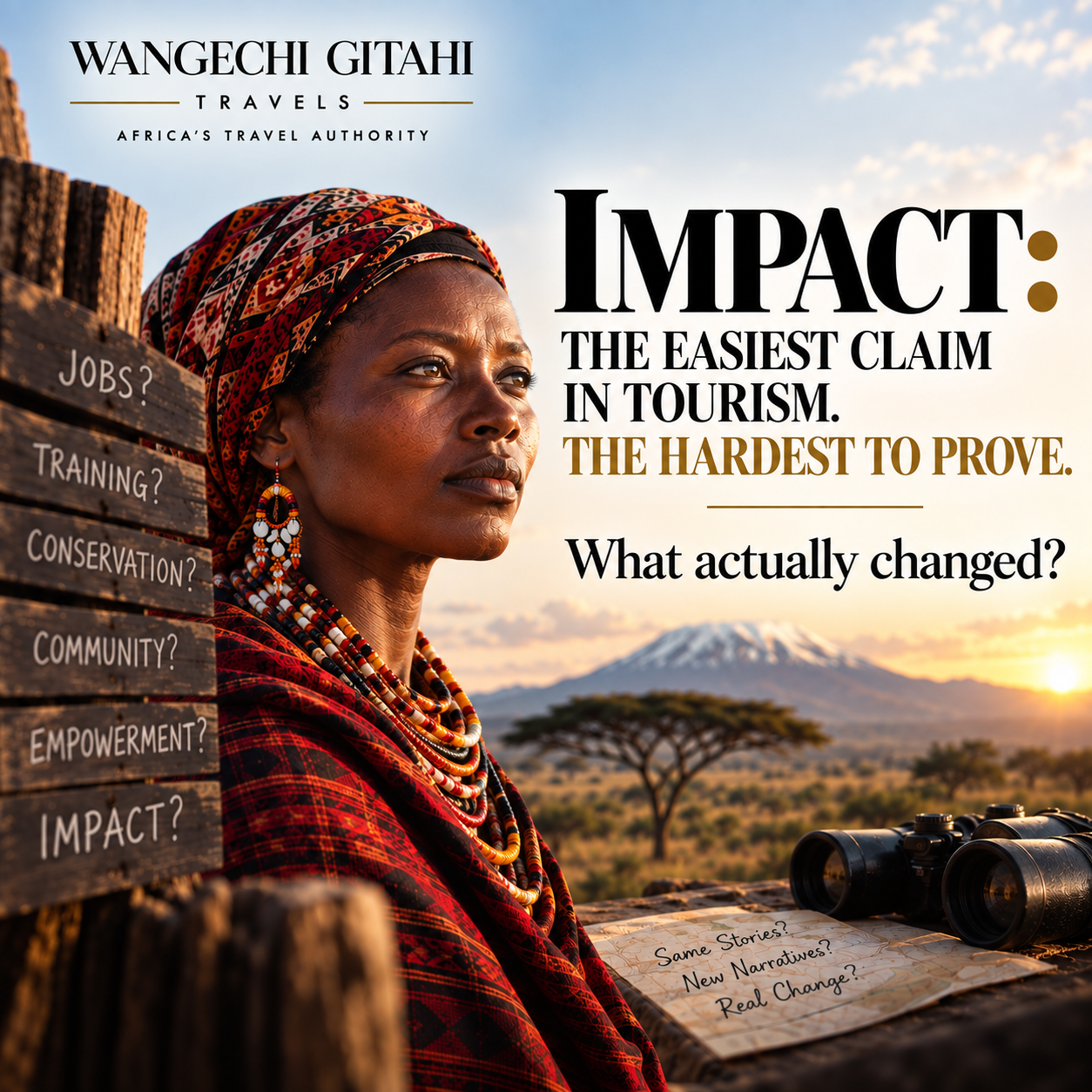
And now: “Impact.” What actually changed?
The more I think about these words, the more I think the conversations are connected. Because language isn’t harmless.
Words frame how Africa is sold. They frame what tourism celebrates. They frame what gets funded. They frame what gets measured. And sometimes they allow us to stop asking questions too soon.
“Authentic.” According to whom? “Sustainable.” Show me. “Impact.” What changed?
Perhaps African tourism doesn’t need fewer ambitious words. Perhaps it needs a higher burden of proof for using them.
WHAT CHANGED ON THIS SIDE OF THE PHOTOGRAPH?
A tourist comes to Africa.
They see an elephant in the wild for the first time. They watch the sun rise over the Mara. They meet people they would never otherwise have met. They eat something new. Hear stories. Laugh. Cry.
Something shifts. They go home different. And they say:
“That trip changed my life.”
Beautiful. I mean that. That is part of what makes travel extraordinary.
But perhaps there is another question we should be asking:
What changed on this side of the photograph?
Because the traveller can go home transformed. But what about the African whose land created the view? Whose wildlife created the experience? Whose labour made the journey possible? Whose culture made it memorable? Whose story gave it meaning? Whose face sold the brochure?
What changed for them?
Not: Were they saved? Not: Did one tourist transform their life? That’s not the point.
The question is whether the tourism economy built around all that value left meaningful value behind.
Maybe somebody built a business. Maybe a family gained reliable income. Maybe conservation became economically viable. Maybe a woman gained access to a market she didn’t have before. Maybe local farmers became suppliers. Maybe a community acquired equity. Maybe a young person moved from employee to entrepreneur. Maybe tourism genuinely changed the economic trajectory of a place.
Fantastic.
Then tell that story. Measure it. Follow it. Prove it.
And if nothing much changed? Perhaps we need the courage to say that too.
Because tourism can be successful without pretending every success is impact. Tourism can be powerful while still being challenged to do better. In fact, I would argue that an industry as important to Africa as tourism deserves that level of honesty.
So the next time a brochure, sustainability report, funding proposal, conference presentation—or one of us—says, “We made an impact,” I hope somebody asks:
What actually changed?
And I hope we have an answer.
Not the word. The standard.
This is the third piece in my ongoing series interrogating some of the words African tourism uses very confidently.
READ THE SERIES
“Untouched. ‘Authentic.’ The Most Dangerous Words in African Tourism.”
“Sustainable: The Most Confident Word in African Tourism. The Least Measured.”