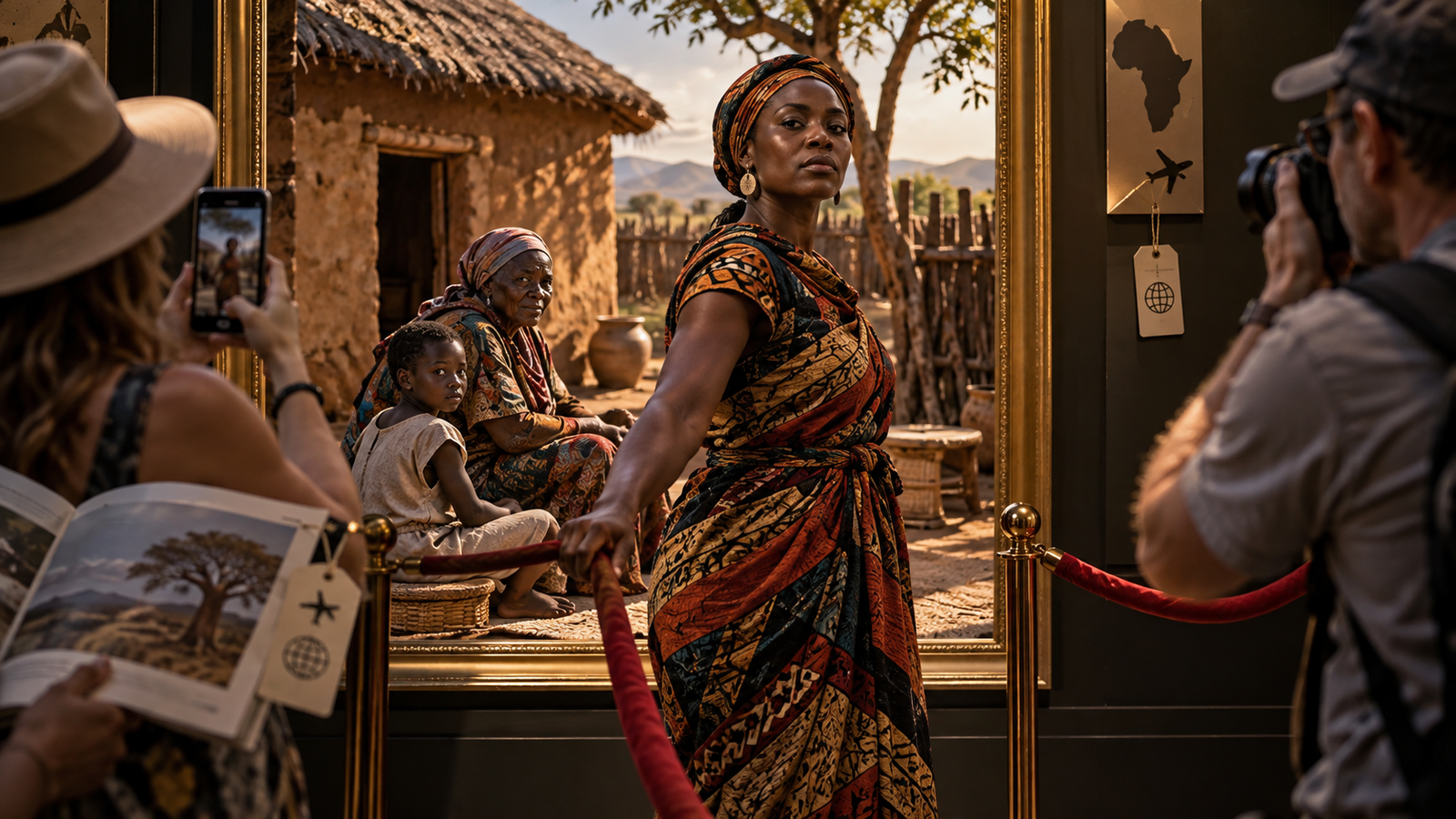
Community-Based Tourism. Who Decided the Community Wanted to Be the Product?
There is a sentence the tourism industry says with remarkable confidence: “We involve the local community.”
I have heard it in boardrooms. On panels. In funding proposals. In sales meetings. And almost every time it is said, something interesting happens.
The conversation ends. Nobody asks the next question.
So let me ask it.
Did anybody actually ask the community if they wanted this?
Not if they wanted jobs. Not if they wanted a classroom. Not if the chief would sign. Not if tourists would spend money.
Did they want their homes, faces, ceremonies, stories, children and culture to become part of a tourism product?
Because somewhere along the way, tourism became very comfortable selling places. Then it started selling people.
A village became an excursion. A home became an attraction. A ceremony became entertainment. A woman became a photograph. A child became atmosphere. A culture became an itinerary.
And the industry called it community-based tourism.
Sometimes it is. Sometimes it is not.
Sometimes it is simply:
tourism based on a community.
Those are not the same thing.
And the difference is power.
Let us look at who builds what
The community gives the experience its value. Their homes. Their dances. Their ceremonies. Their beadwork. Their food. Their stories. Their faces. The children waving beside the road.
Everything that makes the traveller say:
“Wow.”
Then everyone else builds the business around them.
Someone designs the itinerary. Someone sets the price. Someone sells it. Someone takes the photographs. Someone owns the website. Someone keeps the client. Someone banks the money.
So here is a simple question.
If you remove the community, is there still a product?
No.
If you reduce what the community earns, does the product still sell?
Very often, yes.
Think about that.
The experience cannot exist without them. But the business can exist quite comfortably without paying them well.
That is not community-based tourism.
That is tourism built on top of a community.
And handing some money back does not settle the question.
The industry loves a good meeting
Tourism loves meetings. Stakeholder forums. Committees. Workshops. Attendance sheets. A group photograph for the report.
Then everybody goes back to their offices and makes the decisions.
And because people were in the room, it gets called community-led.
But being in the room is not the same thing as holding power in the room.
In 2019, Kenyan researchers Bonface Kihima and Paul Musila examined community participation at the Mwaluganje Elephant Sanctuary in Kwale County. Mwaluganje matters because it is not some obvious tourism horror story. It is one of Kenya’s pioneering community conservation and tourism initiatives.
And still, the research found something we should pay attention to.
Landowners participated. They gave views. They received benefits. They consented to land being used.
Yet their ability to ensure agreed decisions were actually implemented remained limited.
The study recorded compensation to landowners of less than USD 5 per acre per year over the preceding five years, alongside community benefits including schools, dispensaries, water and bursaries.
Read those two things together.
Benefits.
And less than five dollars per acre per year.
The researchers had a word for this kind of participation: tokenism.
This is why the word benefit should never end the conversation.
So when I hear, “We consulted them.”
Fine.
Could they have said no?
“They are represented.”
Fine.
Who chose the representative?
“They participate.”
Fine.
In what? Who designed it?
“They benefit.”
Fine.
How much? Who decided?
Because:
An attendance sheet proves people were present. It has never proved they were in charge.
“The community agreed.”
Which community?
Tourism says “the community” as though hundreds or thousands of people somehow share one mind.
They do not.
A community has elders and young people. Women and men. People with land and people without it. People with influence and people nobody listens to. People who want tourism. People who tolerate tourism. People who profit from tourism. And people who simply have to live with it.
So who agreed?
And who will the tourist actually photograph?
Very often, they are not the same person.
A chief signing does not mean every woman agreed to be photographed. A committee voting does not mean every young person wants to perform. A parent nodding does not automatically mean a child’s image should become marketing material.
An agreement signed ten years ago cannot automatically speak for the people who were children when it was signed.
The community said yes. Nobody asked her.
Sit with that.
Because collective approval cannot become permanent permission over individual human beings.
Sometimes the word community includes people.
Sometimes it conveniently hides them.
Poverty is not consent
Now comes the answer tourism reaches for.
“But they earn from it.”
Yes. Sometimes they do.
And that money matters.
Nobody serious is arguing that communities should earn less from tourism. Tourism can create jobs, businesses, markets, education, conservation income and opportunities that did not exist before.
Good.
But economic benefit does not automatically make the terms fair.
If tourism is one of the only ways a woman can earn money, and participation requires opening her home, performing for strangers, being photographed and accepting a price she did not set, what exactly did she choose?
Tourism on somebody else’s terms?
Or no income at all?
That is where the industry needs to be very careful about waving a yes around as proof that everything was freely chosen.
Because:
Poverty is not consent.
The industry is far too quick to treat participation as agreement and payment as permission.
If someone cannot afford to say no, their yes deserves far more scrutiny than tourism usually gives it.
Otherwise the payment proves one thing:
Money changed hands.
It does not automatically prove that power did.
A yes from someone who cannot afford to say no is not consent.
It is a receipt.
The benefits
Then comes the word that ends almost every argument.
Benefits.
“The community benefits.”
Fine.
Who decided what the benefit would be?
A borehole. A classroom. A bursary. A dispensary. A small share of a gate fee.
These are good things. Truly.
But look carefully at what communities can sometimes receive, and what remains elsewhere.
They receive donations. Someone else retains ownership.
They receive wages. Someone else retains the customer.
They receive a percentage. Someone else sets the price.
They perform the experience. Someone else owns the business.
What they receive may be generous.
What is retained is power.
And slowly, benefits can become a sort of moral entry ticket.
“We built the school.”
“We support the community.”
“We fund the borehole.”
Wonderful.
But none of those things purchases permanent access to people’s lives.
Kindness should never be the price of getting in.
Then the camera comes out
A tourist sees a woman. Her beadwork is stunning. The light is perfect.
Click.
Maybe she was asked. Maybe she wasn’t. Maybe she smiled.
But what exactly did she agree to?
That photograph? A personal holiday album? Instagram? A tour company’s website? A destination campaign? A brochure? A magazine? A commercial advertisement? A stock-image platform? An image copied and reused for years?
The photograph takes a second.
It can travel for decades.
The traveller gets a memory. The photographer gets an image. The tour company gets marketing material. The destination gets content. The platform gets engagement.
Everybody can extract value from that photograph.
Except sometimes the woman whose face made it worth taking.
Agreeing to a photograph is not automatically agreeing to have your face used to sell something.
A smile is not a signature.
Buying her beadwork does not buy her image.
And ten dollars does not buy somebody’s face forever.
Tourism cannot speak endlessly about sustainability while treating human dignity as an unlimited resource.
Lions get more space than grandmothers
Think about how carefully tourism treats wildlife.
Keep your distance. Do not disturb. Do not feed. Do not alter natural behaviour. Stay in the vehicle. Respect their space.
Excellent.
Now think about people.
Come closer. Walk into the home. Meet the children. Ask questions. Watch the ceremony. Take the picture.
There are rules to protect a leopard’s space.
There is a timetable for a grandmother’s.
10:00 a.m. Village visit.
11:00 a.m. Traditional dance.
11:30 a.m. Meet the women.
Depart.
Read that again.
A community is not an attraction. It is not a museum that happens to have living exhibits.
People are not scenery. And a community is not an enclosure..
Yet somewhere along the way, people’s lives became tourism inventory.
Homes became attractions. Daily life became immersion. Ceremonies became programming. Children became atmosphere. Poverty became visual texture.
And difference became something to price.
Then comes the demand for “authenticity”
Now it becomes even more interesting.
The traveller wants something authentic.
So tradition is performed.
Again.
And again.
For every group that arrives.
Then heaven forbid the Maasai man checks WhatsApp after the dance. Or the village has solar panels. Or somebody wears sneakers. Or the young person wants to become a software developer instead of carrying on the occupation tourists find picturesque.
Suddenly:
“It didn’t feel authentic.”
Do you see the trap?
Tourism turns people’s culture into a product, then becomes disappointed when they live in the same century as everyone else.
Tourism tells communities it values their culture.
Sometimes what it really means is:
Stay recognisable to the version of you we came here to consume.
That is not necessarily cultural preservation.
Sometimes it becomes cultural confinement.
First tourism packages the person.
Then it complains when the person outgrows the package.
There is a better test
International Indigenous Peoples’ rights frameworks give us a useful discipline: free, prior and informed consent.
The UN Declaration on the Rights of Indigenous Peoples was adopted in 2007 by a recorded vote of 143 in favour, four against and 11 abstentions. Kenya was among the abstaining states.
Not every community tourism project falls under the Declaration or its specific legal and rights context.
But tourism should still be brave enough to borrow the questions behind the principle.
Free. Could people actually say no?
Prior. Were they asked before the experience was designed, priced, marketed and sold? Or afterwards?
Informed. Do they understand what is being sold, where their photographs and stories may go, and who can earn from them?
I would add two more.
Ongoing. A yes last year is not automatically a yes today.
Reversible. People need the ability to change their minds.
Because tourism has sometimes treated consent like a one-off entry permit.
Obtain access once.
Keep it forever.
Human beings do not work like that.
I am not questioning community-based tourism
I am questioning what gets to be called community-based tourism.
Because the real thing exists.
And when it is done well, it can be powerful.
Il Ngwesi in Laikipia is an important example.
The initiative followed an approach from neighbouring Lewa in the mid-1990s. Community elders ultimately agreed to set aside 8,675 hectares of grazing land for conservation, and the lodge was established in 1996. Il Ngwesi describes the enterprise as both owned and run by the community.
That distinction matters.
Not because any model involving human beings is perfect.
But because the direction of power is different.
Listen to these two sentences:
“We bring tourists to the community.”
“The community owns the tourism.”
They sound close.
They are worlds apart.
The first is about access.
The second is about authority.
And much of what is sold as community-based tourism is the first sentence borrowing the second sentence’s name.
Can they say no?
In Impact: The Easiest Claim in Tourism. The Hardest to Prove., I asked:
What actually changed?
This time my question is simpler.
And harder.
Can they say no?
No. That is not our price.
No. You may not photograph that.
No. That ceremony is private.
No. Not today.
No. We will decide how many visitors come.
No. That story is not yours to publish.
No. We are changing the programme.
No. We are working with somebody else.
If a community cannot meaningfully say no, its yes tells us far less than we think it does.
Because:
Power is not demonstrated by somebody’s ability to participate.
Power is demonstrated by their ability to refuse.
I sell African journeys for a living. Some include time with communities.
So these questions are not only for governments, NGOs, lodges or other tour operators.
They are for anyone who sells a journey.
Including me.
So who is checking?
This is where the discussion stops being philosophical.
Kenya’s Cabinet explicitly approved expanding community-based tourism in March 2025 as part of measures aimed at strengthening the tourism sector.
Good.
Grow it.
But define it.
Because as of September 2026, the national tourism portal still lists a Draft National Tourism Policy and a Draft National Tourism Strategy 2025–2030. The Ministry’s own downloads page also continues to surface draft policy and strategy documents.
If a final version exists and I have missed it, point me to it. I will read it, and I will share what it says.
The draft strategy speaks positively about community-based tourism, equitable revenue sharing, capacity building and inclusion.
Again:
Good.
But here is the question I want the final framework to answer clearly:
What must be true before something may legitimately call itself community-based tourism?
Because if the label has no meaningful threshold, almost anything involving local people can wear it.
So before the label expands, define the standard.
Who owns it?
Who set the price?
Do the hosts know what the traveller actually paid?
Who decides what stays private?
Is commercial use of someone’s photograph a separate agreement?
Can an individual refuse even where a collective arrangement exists?
Is consent revisited or assumed forever?
Is there a credible path from working in the enterprise to owning part of it?
Can the community renegotiate?
Can it walk away?
And above everything:
Where does the power sit?
To travellers: ask before you book.
To photographers and media: ask before you publish.
To operators: ask before you sell.
To policymakers and certifiers: make industry players prove it.
Because community-based tourism should mean more than:
tourists visited a community.
If a community cannot say no, it is not community-based tourism.
It is community-branded tourism.
Not everything needs to become an experience
Some things are simply not for us.
That should not be controversial.
Not every ceremony needs an audience. Not every village needs visitors. Not every home needs to open. Not every story needs publishing. Not every child needs photographing. Not every cultural practice needs an entrance fee. Not every beautiful thing needs a booking link.
Tourism has spent decades figuring out how to create access.
Perhaps maturity means knowing where access should end.
A community saying:
“This part is not for tourists.”
is not lost revenue.
It is their decision.
And the answer is not another workshop. Not persuasion. Not a better offer. Not quietly searching for another elder who might agree.
Just:
Understood.
Because respecting culture includes respecting the parts of it we are not invited to consume.
Maybe we have been asking the wrong question
For years, tourism has asked:
How do we involve communities in tourism?
Look carefully at that question.
Tourism sits in the middle.
The industry exists. The product exists. The traveller exists. The investment exists.
Then somebody asks:
How do we bring the community into it?
Turn the question around.
On whose terms should tourism be allowed into a community?
Everything changes.
Now the community is not waiting to be included.
Tourism is asking for permission.
The objective is no longer to make communities useful to tourism.
It is to make tourism answerable to communities.
And perhaps that is where genuine community-based tourism begins.
Not with a village visit. Not with a dance. Not with a donation. Not with a percentage of revenue. Not with smiling women holding beadwork in an annual report.
With power.
The power to decide.
The power to negotiate.
The power to own.
The power to keep parts of culture private.
The power to control how your image is used.
The power to change the terms.
The power to withdraw.
The power to walk away.
And yes:
the power to say no.
So before another itinerary is designed, before another home becomes an attraction, before another ceremony gets a departure time, before another child becomes somebody’s holiday photograph, before another woman’s face sells a destination she does not own, before one proudly types COMMUNITY-BASED EXPERIENCE across another brochure, ask the question we should have asked from the beginning:
Who decided the community wanted to be the product?
And if we cannot answer that clearly, perhaps the problem is not the question.
Perhaps it is the product.
Because real empowerment does not begin when tourism gives communities a seat at the table.
It begins when communities can decide whether tourism gets a table there at all.
Sources
Kihima, B.O. & Musila, P.M. (2019). “Extent of Local Community Participation in Tourism Development in Conservation Areas: A Case Study of Mwaluganje Conservancy.” PARKS 25.2, IUCN. DOI: 10.2305/IUCN.CH.2019.PARKS-25-2BOK.en
United Nations (2007). “General Assembly Adopts Declaration on Rights of Indigenous Peoples.” Press release GA/10612, 13 September 2007. Recorded vote: 143 in favour, 4 against, 11 abstentions.
Il Ngwesi. “The Il Ngwesi Story.” ilngwesi.com
Capital FM / AllAfrica (March 2025). Coverage of Cabinet approval of tourism initiatives, including expansion of community-based tourism.
Ministry of Tourism and Wildlife, Kenya. Draft National Tourism Policy and Draft National Tourism Strategy 2025–2030. tourism.go.ke. Accessed September 2026.

